

Maslahah Shura · Witnessing, judgement, objection, and accountability
HAYR does not remain an abstract claim; Maslahah Shura carries it into reasoned and accountable judgement under concrete conditions.
Maslahah Shura is neither majority vote nor symbolic consultation. It joins the relevant stations of source, vocation, field, affected people, execution, and review; bounds decisions, preserves objection, monitors consequences, and corrects when needed.
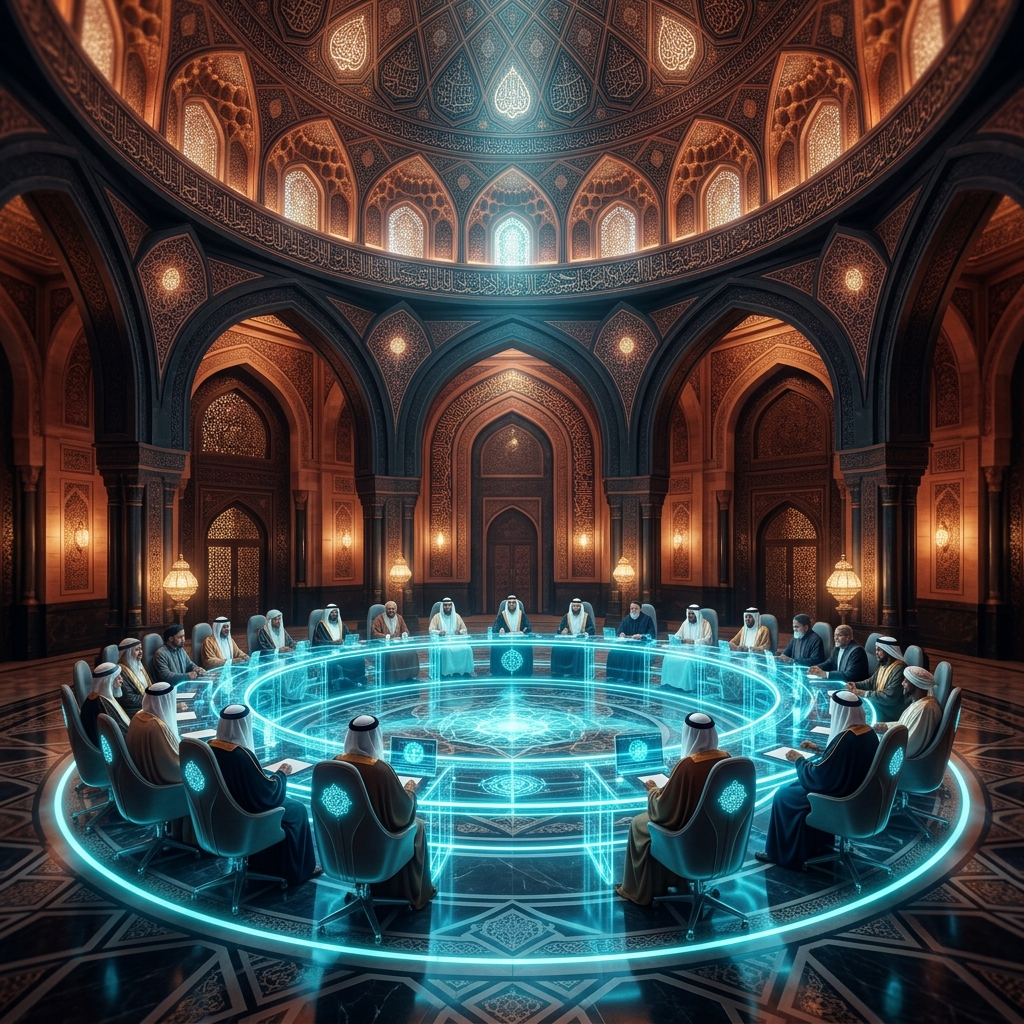

What is Maslahah Shura?
Maslahah Shura is an order of decision that brings distinct stations of knowledge and witnessing together to place HAYR rightly within a particular people, time, place, and scale.
Within RUYAH, Maslahah Shura is neither a prestige board, symbolic advisory body, nor majority vote. Scholars and people of method, relevant vocational experts, field witnesses, implementers, affected people, and when needed bearers who protect the rights of children, family, nature, or future generations gather around one question. Its task is not to vote Truth into existence, but to mature how HAYR should be applied—by whom, within which boundary, through which path, and under what accountability—while preserving constants and limits.
Shura does not produce Truth; it draws limited human knowledge, distinct witnessing, and responsibility closer to sound judgement.
Three movements of Maslahah Shura
Gather witnessing, mature judgement, and review consequences again.
Shura is not merely asking for opinions. Relevant knowledge, competence, field experience, and affected voices meet; the placement of HAYR under concrete conditions becomes reasoned, bounded, and accountable judgement.
Gather Witnessing
Make missing voices visible across source, vocation, field, data, affected people, the unheard, and future generations.
Mature Judgement
Weigh HAYR, MASLAHAH, SEDD, IHSAN, priority, scale, capacity, and potential harms together.
Review Again
Do not make a decision immutable; keep correction, withdrawal, or renewal open when consequences, harm, new knowledge, or conditions change.
What is Maslahah Shura not?
Maslahah Shura is not majority rule, an unauthorised fatwa body, a way for administration to evade responsibility, or theatre of consultation.
Shura does not assume that everyone has equal knowledge of every matter, yet it also refuses a closed centre in which only title-holders may speak.
It does not vote on TruthMajority, approval, or consensus does not replace revealed constants or sound knowledge. It does not imitate fatwa or judicial authorityWhere fiqh, law, or formal authority is required, the relevant competent station remains distinct and is not replaced. It is not a symbolic advisory boardHolding a meeting is insufficient; witnessing, rationale, objection, decision, responsibility, and review enter the record. It does not free administration from responsibilityWhoever holds final authority and execution remains accountable; “the shura said so” is not an escape. It is not endless discussionUncertainty remains visible, while decision time, provisional judgement, trial boundary, and review date are defined. It does not suppress conflictMinority views, reservations, and warnings of harm remain through separate reports and appeal paths.
Stations within Shura
Not every participant represents the same thing; source, judgement, field, impact, execution, and accountability remain distinct.
Sound shura does not turn everyone into one title. The necessary stations are determined by the question, and the scope of each person’s speech remains visible.
People of Source and Method
Clarify constants, concept stations, fiqh and methodological limits, and the order of evidence.
Vocational and Technical Experts
Witness concerning method, feasibility, cost, safety, data, care, and technical side effects.
Field Witnesses
Make visible how the decision meets real people, place, time, labour, nature, and service.
Affected Voices
Those carrying the consequences express experience, needs, rights, harms, and objections directly.
Implementing Steward
Carries feasibility, authority, budget, duty, records, and care.
Reviewer and Accountability Station
Guards conflicts of interest, SEDD, IHSAN, outcome measurement, objection, remedy, and renewed review.
The Shura decision chain
A question becomes judgement, judgement becomes bounded action, and action returns as witnessing and renewed judgement.
A Maslahah Shura decision is not a sentence completed in one meeting, but a cycle with explicit stages, responsibilities, and paths of return.
Define the Question
State scope, addressee, urgency, unknowns, and the consequence of not deciding.
Identify Constants and Limits
Distinguish revealed constants, law, ADAB, SIDRA, privacy, children, human rights, and irreversible-harm boundaries.
Gather Witnessing
Make source, vocation, data, field, affected people, alternatives, and conflicts of interest visible.
Form MASLAHAH Judgement
Give reasons for which option, scale, duration, boundary, and priority will carry HAYR under the conditions.
Bounded Execution and Record
Define responsible person, budget, duration, SEDD, success/harm signals, stop threshold, and care.
Review Consequences
Continue, change, withdraw, or remedy the decision in light of real results, objections, and new knowledge.
Objection, minority view, and correction
The maturity of shura is measured not only by agreement, but by deciding without losing objection.
It is not sound to dissolve every difference into one text. Reasoned reservation, minority views, and warnings of harm remain part of the decision record.
Reasoned Objection
Objection addresses evidence, risk, rights, feasibility, or missing witnessing rather than attacking persons.
Minority Report
A competent dissenting view is recorded separately with reasons and anticipated risks.
Stop Threshold
When defined harm, rights violation, or safety indicators appear, action stops automatically or through authorised intervention.
Reopening
New evidence, changed conditions, or harm in implementation may reconvene the shura.
Remedy and Reconciliation
A wrong decision is not corrected only in text; rights, return, apology, remedy, and system change are addressed.
Archive and Learning
Objection, error, and correction enter institutional memory so future bearers do not pay for the same failure.
Conflict of interest and independence
Trust in shura depends not only on competence, but on making interests, proximity, fear, and dependencies visible.
Conflict of interest does not automatically make a person guilty; hiding it corrupts judgement and witnessing.
DisclosureFinancial interest, family relation, institutional loyalty, prior decision, personal rivalry, and reputational risk are declared. RecusalWhen conflict may affect judgement, the person withdraws from discussion, vote, or execution. Independent WitnessingCritical questions do not rely only on internal knowledge; external field, independent experts, or affected people verify. Financial and Data TransparencyBudget, incentives, data sources, model recommendations, and measurement methods enter the record. Protected ReportingThose reporting harm, pressure, or irregularity are protected from retaliation; the channel is not closed under management. Periodic RenewalThe same people do not become a permanent decision centre; term, rotation, renewed competence, and accountability apply.

Human judgement and technical tools
Data, models, and automation may present evidence and scenarios to shura; they cannot own judgement or responsibility.
BA Internet tools may collect information, generate alternatives, find contradictions, and monitor consequences. Yet intention, FURQAN, RUSHD, witnessing, MASLAHAH, and accountability remain with the human in BA Intelligence.
A model does not decide; people decide what the model sees, what it leaves out, and under which responsibility they rely on its result.
Emergency and provisional judgement
Emergency does not abolish shura; it shortens decision time, narrows authority, and makes later review obligatory.
Fire, security, health, data breach, or irreversible harm may require rapid action. Yet exception must not become permanent governance.
Limit of Emergency Authority
Who may decide, under which event, scope, and duration is defined beforehand.
Minimum Witnessing
Even under time pressure, relevant technical knowledge, affected rights, and essential SEDD are not fully abandoned.
Record Requirement
Time, rationale, data source, authorised person, and expected risk are recorded immediately or at the first possible moment.
Sunset Rule
Provisional action expires automatically on a defined date; continuation requires normal shura and renewed reasons.
Post-Review
The correctness, harm, proportionality, and remedy needs of emergency action are independently reviewed.
Prevent Normalisation of Exception
Emergency authority does not become precedent for permanent surveillance, central control, or objectionless rule.
Voting and Shura
Voting is a decision technique; shura is the entire order of knowledge, witnessing, judgement, objection, and accountability.
Voting may be used in some questions, but a numerical result alone does not show sound judgement, competence, or justice.
Voting-only logic
A shortcut that treats number as the decision itself
- Every view is treated as equal in knowledge and impact
- Options may remain immature before voting
- Majority may hide minority rights and warnings of harm
- The count displaces the rationale
- Executor, stop threshold, and renewed review may remain unclear
- The losing view may disappear from institutional memory
The order of Maslahah Shura
Judgement matured through competence, witnessing, rights, reasons, and accountability
- Each statement is assessed within its station of knowledge, field, and impact
- Options, alternatives, and irreversible harms are made visible first
- Minority views, reservations, and affected rights remain in the record
- Decision is explained with rationale, scope, term, responsibility, and limits
- SEDD, stopping, objection, remedy, and renewed review are built beforehand
- Even when voting is used, judgement is not reduced to number
Maslahah Shura in the SAHN-I BA ecosystem
Shura is not one central board, but a layered order extending from nearby circles to higher review according to the scale of the question.
Not every decision rises to the principal shura. Local and vocational questions remain near competence; matters involving constants, high harm, cross-institutional impact, or irreversible consequences move to wider review.
Circle Shura
Matures questions of learning, relation, participation, and nearby circle order with members and facilitators.
Go to CirclesKARDESH Vocational Shura
Addresses vocational ADAB, standards, competence, labour, lawfulness, technology, and guild questions.
See KARDESHMission / Lab Review
Reviews project, data, prototype, safety, SEDD, user, and real-field decisions in multidisciplinary teams.
Go to MissionsSAHN and SEFER Shura
Reviews public opening, representation, hospitality, children, privacy, place, route, and service.
See SEFERWAQF Stewardship Shura
Guards open knowledge, licensing, data, resources, space, care, access, and intergenerational continuity.
Go to WAQFMaslahah Shura
Brings relevant stations together in questions involving constants, high impact, institutional conflict, or irreversible risk.
Stay on this pageMaslahah Shura review
Before a shura meeting carries decision authority, it answers these six questions.
The review does not count meetings; it asks whether right stations, missing voices, explicit boundaries, and accountability paths exist.
Are question and authority correctly defined?Is it clear what the shura decides, what it only advises, and which station it cannot replace? Are necessary stations represented?Are source/method, vocation, field, affected people, execution, and reviewer voices present as required? Are conflicts of interest visible?Were interests, relations, institutional ties, data sources, and model incentives disclosed and recusals made? Is the decision reasoned and bounded?Are HAYR, MASLAHAH, alternatives, unknowns, duration, scope, responsible person, and stop threshold written? Are objection and remedy available?Are minority views, reopening, harm reporting, withdrawal, remedy, and protected reporting explicit? Will the decision be reviewed again?Are outcome measures, review date, sunset rule, archive, and next-bearer responsibility defined?
Closing the RUYAH series through shared judgement
Maslahah Shura is not a final station that changes RUYAH’s constants, but an accountable gate carrying all concepts together into real questions.
The path beginning with Revealed Constants and Limits reaches shared judgement through Truth, Representation, Tajdid, Tahafut, ADAB, EDEB, BA, SIDRA, MA, SEDD, IHSAN, MILLET, SAHN, HAYR, UMRAN, the Concept Atlas, and Bearers. This page completes the series, but does not close RUYAH. Every Mission, institution, technology, education, space, and WAQF decision lives by returning to these concepts.
Deeper reading
Continue in the Külliyat Library
The portal summary offers direction; the Külliyat record keeps the source, context, and path to longer reading visible.
Atlas
RUYAH Concept Atlas
A concept atlas showing the relations among ADAB, EDEB, TE'DIB, SIDRA, MA, SEDD, İHSAN, SAHN, TEMSİL, MİLLET, and WAQF.
Open the Külliyat recordBook
RUYAH, SAHN.BA and SEMANIYYA Külliyat
A preparation record for a proposed Külliyat that would bring together sources related to RUYAH concepts and the portal architecture.
Open the Külliyat recordReport
BAI Human Oversight Report
A preparation record for a proposed report on human decision, contestability, reversal, representation, and responsibility in the use of models and automation.
Open the Külliyat record